Unpopular Opinion: Air Strikes Are Acts of Love

tattered-american-flag_2436462Living in Korea taught me a lot of unexpected lessons, not the least of these are tied to the US military. I learned a lot about the men and women serving our country during that year, and dating an Air Force Staff Sergeant has taught me even more than I could have learned on my own. You see, before I left for Korea I would have considered myself a left-leaning moderate. Like most Americans, though I considered some force justified in specific situations, I couldn’t wrap my head around the whole killing other people thing.

From the outside, it looks like our soldiers kill insurgents. It appears that air strikes, while largely harming civilians, are probably a necessary evil in times of war. Many of us can even justify the killing of civilians for “the cause”–whatever that is. However, I always saw these deaths as a sort of elitist scapegoat. From the outside, it appears that American service members look at the people they’re fighting and see something less than human, less than themselves. And from the outside it appears that this is how killing is justified.

We are all familiar with the rhetoric that these gun-wielding, sandal-wearing, IED-burying men (and women) are “animals.” And as such, we can justify the killings. They are not human, they are “animal” and they are undeserving of our compassion. Now, the left-leaners get all hot and bothered at this point, talking about how these are people, not animals, and that killing them indiscriminately makes our brave men and women the animals, or monsters. I agree that this as justification for the deaths of innocents takes us to a level of “monster” I’m not comfortable with. But this is all the view from the outside.

The media baits us, all of us, throughout the country, with it’s harmful and misleading rhetoric. From the outside, we see our armed forces killing civilians without concern. From the outside, war-mongers and conservatives shoot off their guns in rag-head justice approval. From the outside, liberals watch the decay of the empathy and intelligence that brought out the highest highs of humanity. From the outside it looks like it’s “us against them,” but if history has taught us anything, it’s that this war doesn’t matter. That’s not to say it isn’t a necessary evil, but consider the fact that the United States is the ONLY country to ever drop a nuclear bomb. And the country we crippled is now one of our strongest Asian allies. We put Japanese-Americans in camps in our own country because we feared them, and now we’re best buddies.

The view from the inside looks much different, from what I’m beginning to understand. With few exceptions there are no men or women that really enjoy taking a life. And the ones sent to do just that are pawns in this dangerous game, controlled by someone who gets paid a helluva lot more than they do. Our gun-wielding, boot-wearing, air-striking patriots do not decide where to go and who to kill. Those decisions are far beyond their pay grade. They simply do all they can to ensure that the guy to the left and right of them gets home.

It’s as simple and as complicated as that. Drone strikes are an act of love when called upon to cease the gunfire. Someone is proud of their job calling in air strikes because it allows them to keep their guys alive. They kill because they love.

In a way this does become an “us against them” mentality, almost indiscriminately. But, rather than viewing air strikes as something disconnected and impersonal, I challenge other laymen (as I am absolutely one of these when it comes to the military) to see it as intensely personal–more than you could possibly imagine. Do you think that, given the technology, the man shooting at you wouldn’t hit the red button and blow you sky high? Sure, maybe he’s doing it for some convoluted and fetishized version of God, but he’s also doing it to save his own ass. To save his buddies’ asses. To keep his family and his way of life safe.

Air strikes are acts of love that cause carnage. Tell me about a time where love existed and there was no danger. Tell me about the time you loved someone and there was no passion. There would be no need for love if it weren’t for hate. Sometimes the most beautiful acts of love are disguised as inexcusable acts of war. Perspective. In war, killing is an act of love.
War Crimes in Indochina


The sky above Vietnam.

I left Hoi An for Saigon (Ho Chi Minh City) and stood on the grounds of modern history. The busy streets of Saigon were more friendly than those in Hanoi, but equally as crazy.

The palace, where the South Vietnamese finally surrendered.

The Post Office in Saigon.

The Vietnam War was a crazy time. It was a war my father was drafted into. It is something I can talk about with many of my family members for a first hand account of what that was like. This wasn’t some battle thousands of years ago that’s completely unrelatable. This was recent and super intense. In one day we visited the Cu Chi tunnels and the American War museum. I had some really intense mixed emotions going on.

Actual size entrance to one of the VCs tunnels.

The two hour drive from HCMC to Cu Chi was pretty uneventful, save a tourist trap stop that featured people affected by Agent Orange exposure creating Vietnamese crafts, and a video about the American war.

To be fair, this video looked like 1960s propaganda. It was super retro and played in black and white. But, honestly, I had never felt a huge, overwhelming, sudden surge of patriotism so intense before watching this video. The video showed re-created battle scenes and talked about the war and the people who fought. The Vietnamese weren’t paid to fight in money, but in honor. So they introduced people who won medals for “killing 160 Americans” and things like this. After 10 minutes I fell asleep and just couldn’t listen to it anymore.

Inside one of the entrances to the tunnel system.

The tunnel tour was super basic and that was fine. The tunnels made me feel claustrophobic and I cannot imagine living like that. Considering how I felt makes me understand more tangibly the situation above ground for all people. Definitely not a good place.

B52 bomb crater.

Here we were taken down a path and shown various life size dioramas of how the Vietnamese handled the war at home, as well as some tunnels and traps. Like I said, the tunnels made me claustrophobic, but the re-created traps made me sick. Thinking about the thousands of Americans that died or were maimed in these traps, people whose story is still discussed first-hand, got me angry. I don’t think either side of the war was in the right, and I believe that awful acts were committed by both the Vietnamese and the Americans, but I was upset at that place. It was a strange feeling to see war from the perspective of the other side.

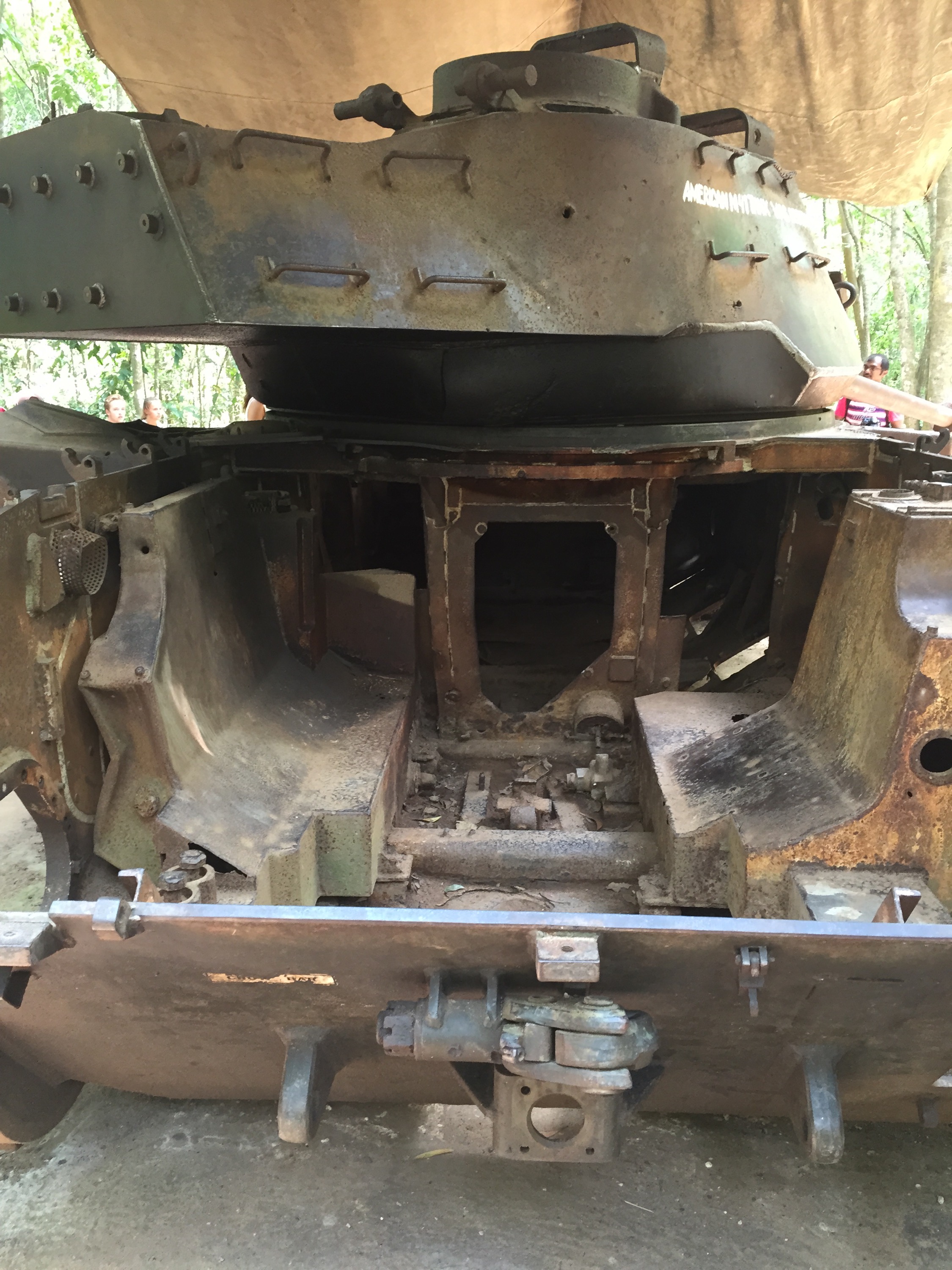
U.S. tank .

Seeing as my countrymen died in this tank, I felt like I shouldn’t smile. But I did. Because I can be awkward.

After the tunnels it was time for the American War museum. Now, many people would say that this is all just a bullshit propaganda museum. They probably wouldn’t be wrong, but I have to believe that at least some of it is true, even if I don’t want to. Seeing pictures of extreme ailments and deformities caused by Agent Orange exposure, pictures of American soldiers behind beheaded VC, recovered ammunition, guns and weapons, kinda fucked me up. I mean, I cried a significant amount in there. Thinking about their lives and their families really made me so sad. I saw the cages prisoners were kept in, and there were lots of US military vehicles outside, as well.

So at this point I’m feeling an overwhelming sense of American pride and shame simultaneously. It was a weird day, emotionally, so I ended it with a few beers.

Two days later I was at the Killing Fields in Cambodia.

Tuk-tuk in Phnom Penh, Cambodia.

Mankind is capable of such beautiful and terrifying extremes. Every beautiful thing I know and love is, somehow, connected to humanity, but so are my nightmares. The Tuol Sleng Genocide (S21) museum and The Choeung Ek Killing Fields are stories of horrors even more recent than the American War in Vietnam.

Human remains on display at the memorial pagoda at Choeng Ek.

The museum is in the same buildings and rooms that were used to torture and detain prisoners arrested by the Khmer Rouge in Phnom Penh. Each room contains pictures, beds, restraints, cells, or a combination. There are rooms filled with mug shots taken upon arrival at S21, almost all of which were murdered during the Khmer Rouge genocide that killed nearly 2.5 million people. There are survivor stories that haunt and always end with a reminder to learn from this and not turn a blind eye again. There are still a few blood stains on the floors of the tiny cells and there are skulls exhibiting how each person was killed. Torture was also explained. It was very hot and a lot of reading, but well worth the understating, especially as a prelude to the Killing Fields.

One of four sides of the memorial pagoda at Choeng Ek.

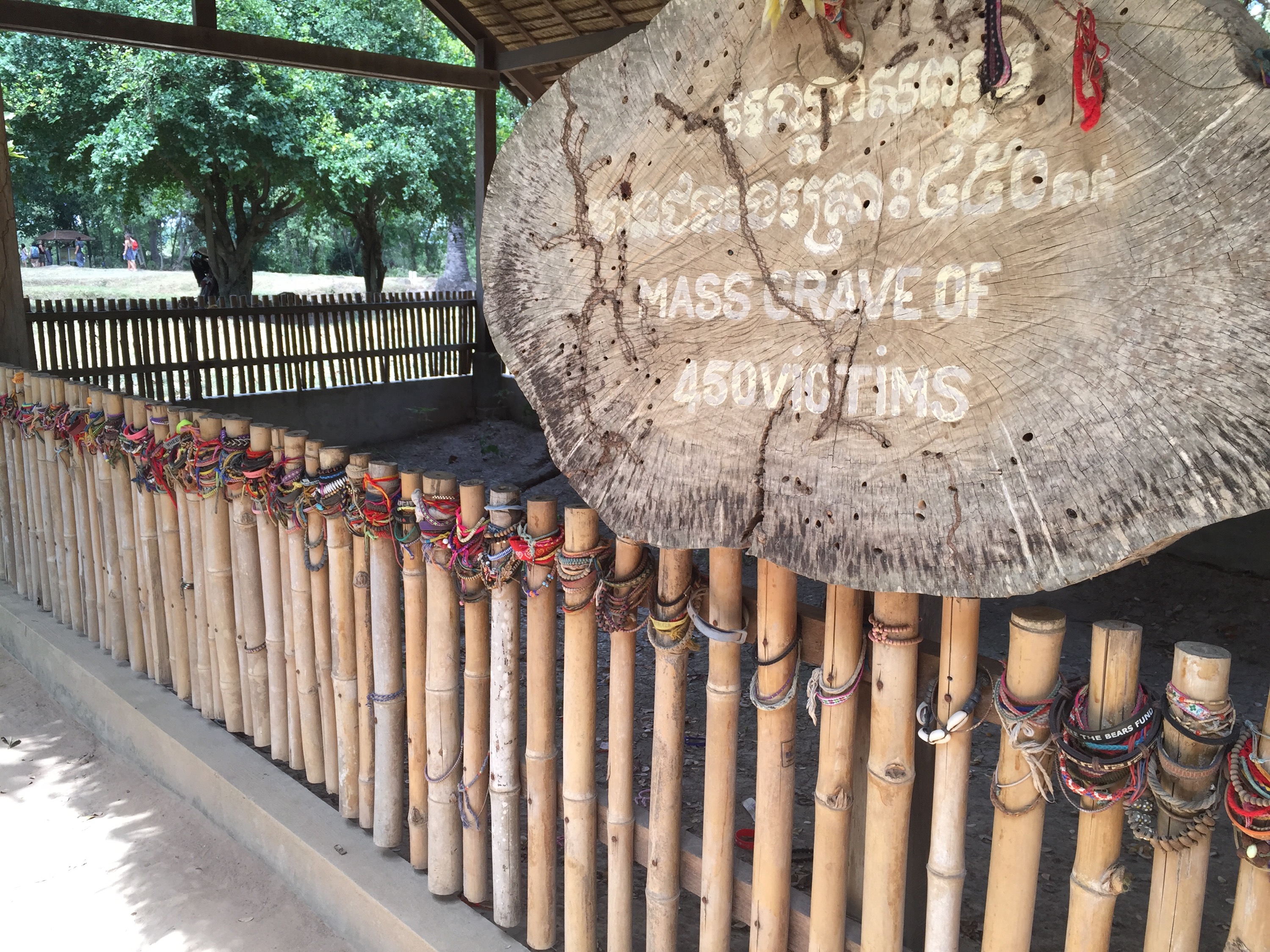
Here you are given a headset in your native language and use it to guide you around the mass graves and former sites of Choeung Ek’s execution site. No matter where you step, you are likely walking on bones. You can see bones and cloth rising to the surface all over the place. The paths tightly wind around the graves, which seem endless, honestly. There are a few graves given special attention, like the biggest one (by amount of people), and the one that was filled with women and children. People have placed bracelets around the fenced area, and even offer food and things at the base of the most chilling place on site.

Mass grave at Choeng Ek.

Because ammunition was scarce and expensive, executioners often bludgeoned people to death. At the killing tree, executioners regularly smashed children against the trunk of a tree until they were dead, and then tossed them into the adjacent pit. When this place was discovered, there was still blood, bone and brain matter on the tree.

The Killing Tree.

The centerpiece here is the memorial pagoda. It is stacked several stories high with skulls and bones of the people found here. Each one is marked with likely cause of death…and it is gruesome.

Memorial Pagoda st Choeng Ek Killing Fields.

Human skulls in the memorial pagoda.

The brutality of humanity is amazing. Terrifying and incredible. And for all the blood that spilled in this area in the last 50 years, the people are welcoming and kind overall. They are poor but never stop smiling. And I can’t help but think about what many of these people must have seen. I guess this is why we travel.

Bones and clothes that have surfaced over the years.